



What is a Sustainability Report (Benefits & Challenges)
Learn what is sustainability reporting, its benefits and challenges, and what a sustainability report includes. Get examples, tips, and report templates.
Set as Preferred Source
Why do organizations create sustainability reports?
Why do companies invest time and resources in these reports? Well, for starters they have a huge impact on how your brand is perceived. But they also affect your ability to raise money.
Many investors and stakeholders nowadays use sustainability reports to assess whether a company’s sustainability efforts align with their personal values and investment goals.
“The nature, quality, and extent of investor interest in the topic of sustainability has grown dramatically… a shift from ‘we never get asked about our sustainability initiatives’ to ‘it (sustainability) comes up in every investor engagement’.”
Since investors are increasingly linking sustainability to long-term success, It’s become clear that companies need to reevaluate their eco-friendly practices for better investor engagement.
1) Objectives and purpose
The primary aim is transparency. Companies want to show they’re accountable for their impact on society and the environment. For example, Coca-Cola publishes a sustainability report to disclose its water usage and recycling initiatives.
2) Transparency and accountability
Transparency is key in today’s “cancel culture.” Stakeholders, including customers and investors, want to know if a company is walking the talk.
3) Decision-making insights
Sustainability reports are rich in data that can inform decisions. For instance, if a company reveals high carbon emissions, it may decide to invest in renewable energy solutions.
What are the benefits and challenges of sustainability reporting?
Let’s weigh the pros and cons.
The benefits of impact reporting are surprisingly concrete. Major companies have seen increased brand loyalty and customer engagement as a direct result of their sustainability reporting.
But the challenges and obstacles are also nothing to sneer at. Data collection, analysis, report writing, and sustainability report design can be resource-intensive.
The truth is, that smaller companies often find it challenging to allocate resources for comprehensive reporting.
What does a sustainability report include?
Let’s dissect the anatomy of these reports.
- The Executive Summary – This is your quick overview. It should encapsulate the essence of the report in a nutshell.
- Scope and Methodology – This section outlines the boundaries of the report and the methods used for data collection. For example, Apple’s report specifies that it includes all of its suppliers and not just the ones directly managed by them.
- Environmental Impact Metrics – Here, companies disclose their environmental footprint. Unilever, for instance, has reduced its CO2 emissions by 50% per ton of production since 2008. Companies are also adopting paperless policies or using plantable seed paper to reduce their footprint.
- Social Impact Metrics – This part talks about the company’s social initiatives. Starbucks, for example, focuses on ethical sourcing and has invested in farmer support centers.
- Governance Structure – This section is about the company’s governance policies. It often includes information on board diversity, executive compensation, and ethical guidelines.
- Financial Performance Overview – This is where the company ties its sustainability efforts to its financial performance. For example, car statistics show that Tesla’s electric cars contribute to revenue while reducing carbon emissions.
- Future Goals and Action Plans – Companies outline their sustainability roadmap. Google, for instance, aims to be 100% renewable by 2025.
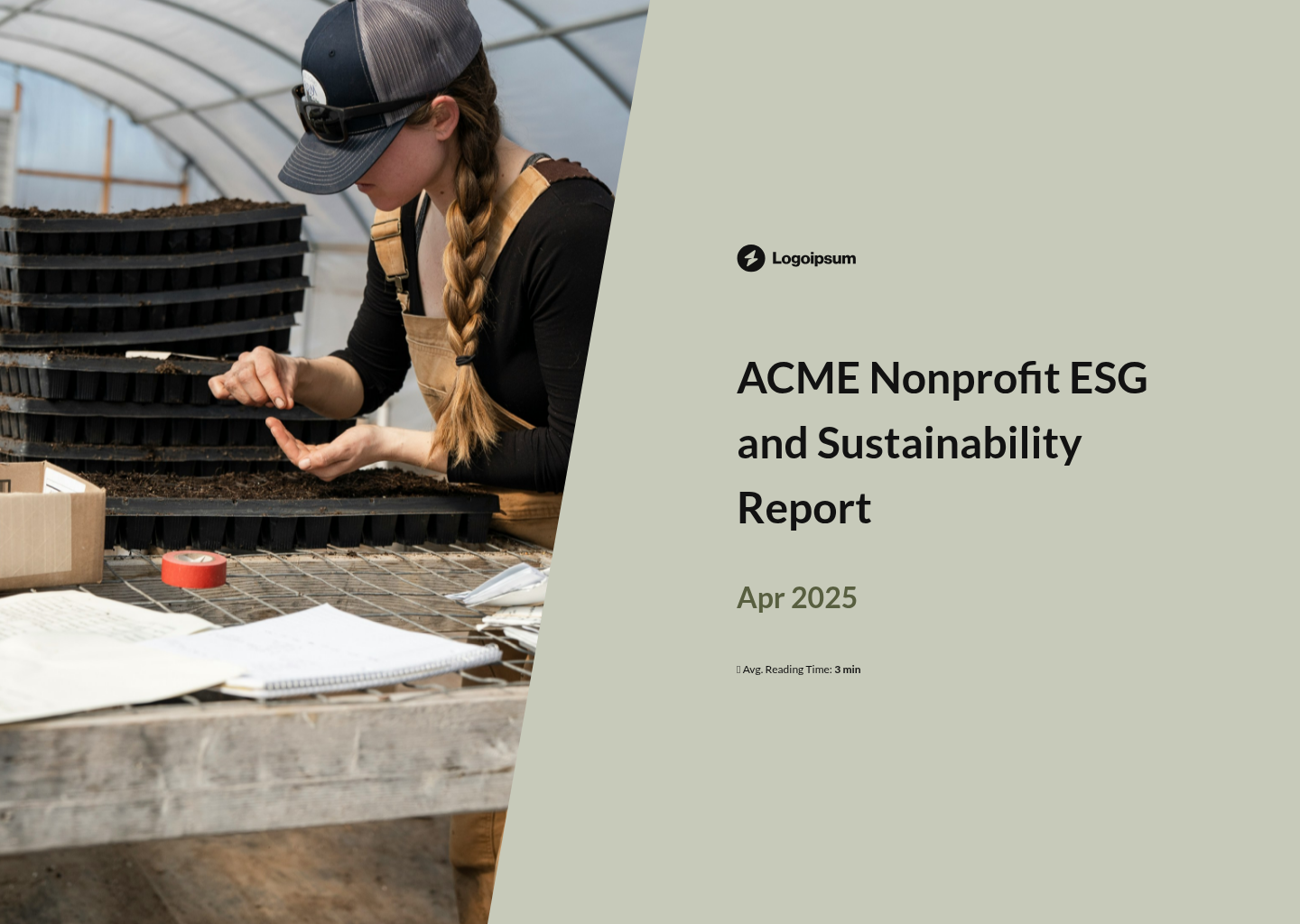
Here’s an example of what a great sustainability report looks like:

Scroll to preview
Common reporting frameworks
How are sustainability reports standardized? Well, I’m glad you asked, cause I just had to share this with someone 😉
1) Global reporting initiative (GRI)
GRI is the most widely used framework globally. It provides a set of universal metrics that apply to companies of all sizes and industries.
2) Sustainability accounting standards board (SASB)
SASB offers industry-specific metrics. If you’re comparing 2 tech companies, SASB metrics can offer a more apples-to-apples comparison.
3) Task force on climate-related financial disclosures (TCFD)
TCFD focuses on climate-related risks and opportunities. Companies like Shell use TCFD to report on their climate initiatives.
4) Integrated reporting framework
This combines financial and non-financial metrics for a more holistic view. Philips, for example, uses integrated reporting to show how its sustainability efforts impact its overall performance.
What advanced concepts should you know?
If you’re a sustainability professional, consider implementing advanced practices like circular economy principles and regenerative practices in your organization.
These can be the difference between a report that creates ripples and a complete dud.
- Materiality assessment – This is a process of identifying what ESG issues are most relevant to stakeholders. Companies like Adidas have used materiality assessments to focus their reporting on key areas like supply chain management and product innovation.
- Stakeholder engagement strategies – Companies often use surveys, interviews, and focus groups to engage stakeholders in the reporting process. For example, Microsoft conducts annual stakeholder meetings to gather input.
- Data verification methods – Look for reports that have been verified by third-party auditors. This adds an extra layer of credibility.
- Circular economy principles – Companies like IKEA are adopting circular economy principles, which focus on reusing and recycling materials.
- Regenerative practices – Beyond sustainability, companies like Patagonia are investing in regenerative practices to restore natural ecosystems.
Is sustainability reporting legally required?
Is this a legal requirement or just a nice-to-have? Like any complicated topic, it depends. Just to be safe you should always check the legal requirements in your country.
Investors will know this of course and will look into this to use it as an indicator of a company’s compliance level.
- Mandatory vs. voluntary reporting – In the EU, for example, large companies are required to publish sustainability reports under the Non-Financial Reporting Directive.
- Non-financial reporting directive in the EU – This EU directive mandates that large companies disclose certain types of sustainability information.
What are the future trends in sustainability reporting?
What’s next on the horizon?
Digital Transformation in Reporting – Blockchain and AI are set to revolutionize how data is collected and reported. Companies like IBM are already exploring blockchain for transparent supply chain management.
Incorporating digital transformation frameworks can further streamline these processes and enhance reporting accuracy, driving significant digital transformation.
The Rise of ESG Investing – With the increasing popularity of ESG investing, sustainability reports are becoming even more crucial for investors.
Keep an eye on technological trends. They’re not just buzzwords; they’re the future of sustainability reporting.
Noteworthy sustainability report case studies
Let’s look at some real-world case studies of sustainability reporting.
Unilever’s sustainable living plan
Unilever’s Sustainable Living Plan report is a gold standard in sustainability reporting. It covers everything from reducing environmental footprint to enhancing livelihoods.
Unilever claims that this plan increased their investors’ engagement significantly and eventually got 99% investor support.

Tesla’s sustainability report
Tesla focuses on its mission to accelerate the world’s transition to sustainable energy. Its report is a fascinating read for anyone interested in clean technology, but also in the different tools that support it, such as eMobility migration software.
Use these case studies as benchmarks. They set the standard for what good sustainability reporting looks like.

Sustainability report templates
These sustainability report templates offer a quick, cost-effective way to create engaging content. Designed to be twice as engaging as traditional formats, these templates save you both time and money.
They’re 5 times faster to produce than agency-made reports and come with interactive features that make your content stand out.
You can easily streamline the report-creation process with a built-in AI assistant, and built-in analytics offer valuable insights into user interaction.
Don’t waste time and money – grab one!

